


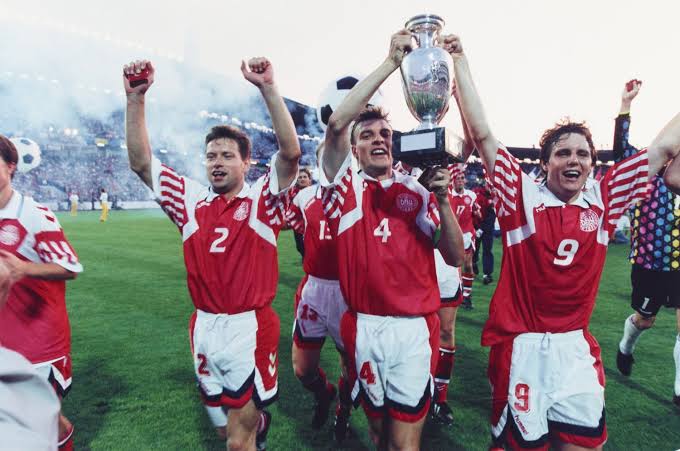
Less often discussed is how that tournament helped expose a fundamental flaw in the Laws of the Game, one that would soon force FIFA and IFAB to act. Denmark did not merely win EURO 1992. In exploiting the back pass rule to its absolute limits, they helped change football itself.
At the time, the back pass rule placed no restrictions on goalkeepers handling deliberate passes from teammates. Defenders could return the ball to their goalkeeper repeatedly, and the goalkeeper could pick it up every time, hold it, slow the game, and reset play without pressure.
What had once been a harmless safety mechanism had become, by the early 1990s, a powerful tool for time management and risk avoidance.
Denmark arrived at the tournament with limited preparation and a clear understanding of their strengths and weaknesses.
Rather than attempting to outplay technically superior opponents, they focused on defensive organisation, discipline, and control of tempo. Central to this approach was Peter Schmeichel, whose presence allowed Denmark to turn the back pass into a strategic weapon.
Throughout the tournament, Danish defenders recycled possession backwards under even minimal pressure. Schmeichel would gather the ball calmly, pause, walk to the edge of his area, and restart play at his leisure.
When opponents attempted to press, the solution was simple. Another back pass, another reset. The cycle reduced risk, frustrated attackers, and steadily drained momentum from the opposition.
The final against Germany offered the clearest illustration of the problem. Once Denmark took the lead, Germany found themselves unable to apply sustained pressure. Every attempted press was neutralised by the same pattern of retreat and reset.
There was no legal way to force a turnover. The goalkeeper could not be challenged while holding the ball, and the defenders were under no obligation to advance play. The match was controlled not through possession in midfield but through legal stalling at the back.
It is important to stress that Denmark broke no rules. They played entirely within the laws as written. However, their success highlighted how poorly those laws served the spectacle of the game.
The tournament followed the deeply criticised 1990 World Cup in Italy, where negative football, low scoring, and excessive time wasting had already alarmed administrators. EURO 1992 provided the clearest evidence yet that the back pass rule was incompatible with a faster, more competitive sport.
Later that year, IFAB introduced a decisive change. Goalkeepers would no longer be allowed to handle deliberate back passes from a teammate’s foot.
Additional limits were placed on how long a goalkeeper could retain the ball. These changes were not cosmetic. They fundamentally altered the balance between attack and defence.
The effects were immediate and lasting. Pressing became meaningful. Goalkeepers were forced to develop ball playing skills. Defenders could no longer rely on a guaranteed escape route.
Matches became quicker, riskier, and more open. Modern football, with its emphasis on tempo and technical ability from every position, can be traced directly back to this moment.
Denmark’s 1992 victory remains a triumph of organisation, belief, and execution. Yet its most enduring legacy may lie beyond the trophy itself. By exposing how the game could be slowed and controlled to the point of stagnation, Denmark compelled football’s lawmakers to act.
They did not simply win a European Championship. They demonstrated that the rules, as they stood, were no longer
fit for purpose.


